Admiral Archie Clemins and the Birth of Network-centric War Fighting
A post this morning on reddit/r/ships reminded me of the command ship for the Pacific Fleet, the USS Blue Ridge, pictured below.
A post this morning on reddit/r/ships reminded me of the command ship for the Pacific Fleet, the USS Blue Ridge, pictured below.
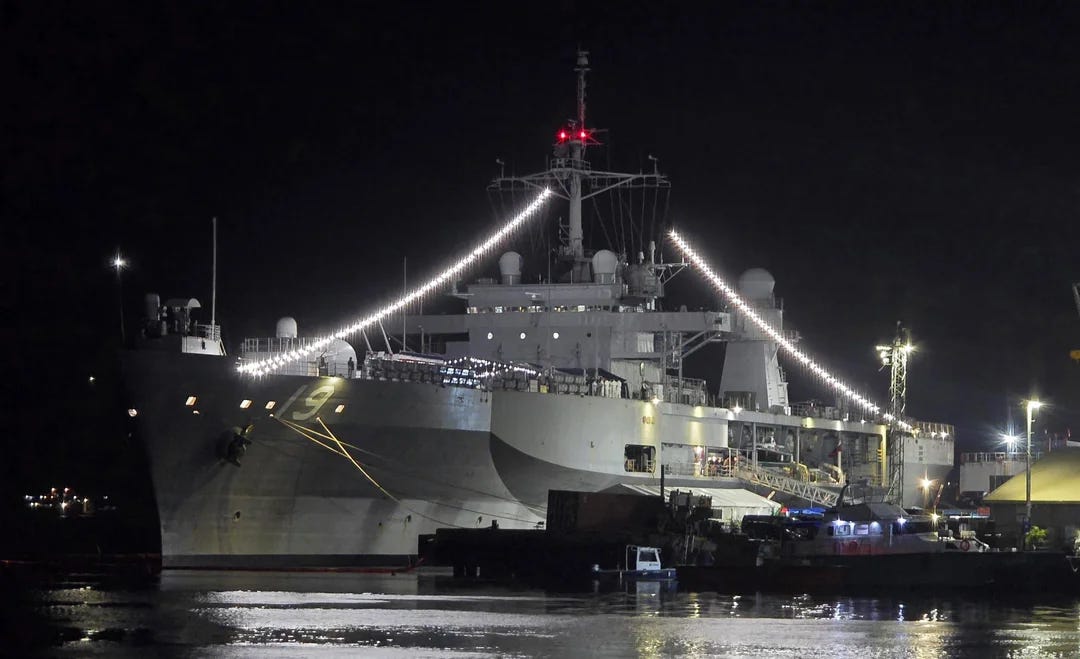
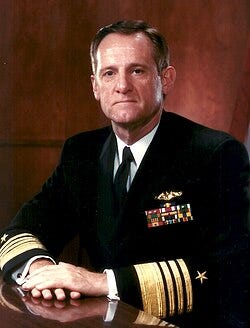
The Blue Ridge featured prominently in the story of Archie Clemins (1948 - 2020) shortly after he was elevated to command of the 7th fleet in the Pacific.
Here is the complete text of the chapter that tells Admiral Clemins’ story as told to me when I was researching: There Will Be Cyberwar: How The Move To Network-Centric War Fighting Has Set The Stage For Cyberwar, which is based on my dissertation for an MA in War in the Modern World from Kings College London in 2014.
CHAPTER TWO
Cautionary Tale
The US military, and indeed most advanced military organizations, have moved to a network-centric war fighting stance with little or no thought, until very recently, to the incumbent vulnerabilities that entails.
In 2011 Leon Panetta, then US Secretary of Defense, joined the chorus of those newly awakened to the reality of the threat of cyber attack against critical infrastructure when he warned of an impending “cyber Pearl Harbor.” But Panetta got his metaphor wrong. An attack against critical infrastructure of the type he and many Cassandras rail on about, one that shuts down the power and communication grids, would be more akin to a terrorist attack than a military surprise attack. The metaphor Panetta should have used was a “cyber 9/11.” A “cyber Pearl Harbor,” if the metaphor were to be correctly applied, would entail a military defeat via cyber means, which the previous chapter attempted to dramatize. In other words, an adversary’s use of computer network attack (CNA) and exploitation (CNE) to gain a tactical advantage that leads to a lost battle, a change in military standing, or even a shift in the geopolitical balance, would be most comparable to the destruction of the Pacific Fleet at Pearl Harbor, on December 7, 1941.
This book takes us on a journey from the development of the Internet, to the exciting days of the new information age, and then to the discovery of the power of networking by the US military. The history of the development of attacks against vulnerabilities in the commercial world has a parallel in the domain of governments, militaries, and war fighting; a parallel that allows us to project into the future. That future vision includes a humiliating military defeat at the hands of a more capable digital adversary. One such scenario, played out in the introduction, was chosen for a particular reason.
The 1995-96 Taiwan Straits Crisis
The history of China and Taiwan is short and consistent. When Mao Zedong finally won the Communist revolution against the Chinese Nationalists in 1949, Chiang Kai-Shek fled with his forces to the adjacent island of Formosa and established a new country, Taiwan. Since then China’s stated goal has been to reunify the two countries. Whether it will be a peaceful reunification (like that of Hong Kong in 1999) or a violent reunification, contributes to the long lasting tension between the two countries. During the Korean War there were multiple armed invasions of Taiwan from China.
In 1991 Taiwanese President Lee Teng-hui angered China with his statements about reunification, leaning away from the One China rhetoric that both countries generally stuck to. Then in 1994 Lee was traveling from South America when his flight was diverted to Honolulu to refuel. The Clinton Administration, cognizant of the delicate situation, bowed to Chinese pressure and refused to grant Lee a visa, forcing him to stay overnight in the plane. Tensions began to rise in 1995 when Lee was invited to speak at his Alma Mater, Cornell University. Congress passed a resolution requiring the State Department to grant him a visa. This was during the lead up to the first fully democratic presidential elections in Taiwan and China took a dim view of the situation. Lee spoke at Cornell in June 1995.
China announced missile tests in a region near Taiwan and began maneuvers on the mainland across the Straits from Taiwan in Fujian Provence. They carried out a series of missile launches into the sea to the North of Taiwan in July. The Clinton Administration took steps to demonstrate that the United States was willing to intercede if China threatened an invasion. In March of 1996 two aircraft carrier battle groups were deployed to the vicinity.
This is where Admiral Archie Clemins comes into the story. Clemins was the Vice Admiral of the US Navy’s 7th Fleet. Only two years before, upon achieving flag rank, he had been assigned to the training division of the US Pacific Fleet under Admiral Frank Kelso. He was also dual-hatted as head of N6, the information technology arm of the Pacific Fleet.
As an “IT guy,” Clemins began to carry a laptop with him, an unusual sight in the 1993 Navy. It was an Apple PowerBook, probably a 160 with 4 MB of memory and a 40 MB hard drive. It was one of the earliest flip top portable computers and had a grayscale LCD screen. It weighed 6.8 pounds.
His Powerbook was his constant companion, even on trips to the Pentagon. He found that people, specifically Admiral Robert J. Kelly, Commander of the Pacific Fleet based in Hawaii, were asking him for copies of the notes he took on his portable. He was living the Information Revolution of the time. “That started the use of computers, we, at Training Group Pacific, led everybody, with desktop computers.”
Shortly after taking on the Pacific Fleet role based in San Diego, Admiral Clemins got a call from the Navy’s Assignment Officer who asked how he liked the weather in San Diego and if he would like to transfer to the Pentagon? The previous week Admiral Keslo, head of Naval Operations, had announced a major reorganization of the Navy and Clemins had been chosen to lead the effort.
As Clemins pulled together a small team within the Pentagon he made sure that they used technology to its best advantage. Clemins credits this use of computers for the success his team had in accomplishing the Navy reorganization in 12 months instead of the 18 months originally slated for it.
Clemins was then appointed Deputy Commander of the Atlantic Fleet at Norfolk to accomplish the same reorganization. “The more I did this the more I came to believe this [computer technology] was the way we were going.”
From Norfolk, Clemins was promoted to commander of the 7th Fleet where he had served as chief of staff years before. He was determined to bring the fleet into the Information Age: “You have to remember the ships of the time, ’93-94 are still moving information at teletype speed.” That meant at most 80 messages a day of 40 lines each. All messages would go directly to the Commanding Officer (CO) who would route them to the appropriate department or personnel.
Clemins’ first task was to assemble a team. He drew from surface, air, and submarine commanders. This was 1995, the year Windows 95 came out, the first commercial operating system with embedded TCP/IP networking capability. Mark Lenci, the submarine captain that Clemins tasked with retrofitting the 7th Fleet, had little experience with networking. His only qualification: he had an AOL account. But no one in the command ranks was an expert and Clemins chose a team that could learn quickly and get things done. When Lanci reported to duty aboard Clemin’s command ship, the USS Blue Ridge, he recalls Clemins saying “let’s go take a walk.” On the flight deck he explained his vision of NCW. “I don’t know what a WAN (wide area network) is but I know we need one. Get the smart guys together here in the Pacific. We are going to do it.” And they were going to do it with commercial off the shelf products (COTS).
The Blue Ridge, the command ship of the 7th Fleet, was the first to be outfitted. Lenci relates how welders were sent on board to cut out bulkheads and toss them into the South China Sea as the Blue Ridge was steaming to port. Ships of the day had stove piped IT infrastructure. Every agency or group that needed computing power deployed their own complete stack of equipment and satellite communication gear. None of the 48 systems, all running different flavors of Unix, could interoperate and none of his team knew how to run them. The satellite antenna system looked “like a pop can with a bundle of straws strapped to it” Lenci recalls.
Lenci was deployed to Washington to scrounge funds from “end of the year” money available from budgets that had not been fully spent. He returned to Japan with $4 million available for the retrofit. He and his team began to outfit both the Blue Ridge and the aircraft carrier USS Independence with a network of Windows 95 machines. Finding bandwidth on satellite comm links proved to be difficult. Most links were controlled by the intelligence agencies and they did not want to cooperate.
So Lenci, who had spent some time at SPAWAR (Space and Naval Warfare Systems Command) called a friend in Cheyenne Mountain. He asked him for a list of all satellite transponders on geo-synchronous orbits over the Pacific theater. Of the list compiled there were seven Inmarsat satellites that were being decommissioned but still had onboard fuel so they could be repositioned. He commandeered these satellites, which to this day are still employed by the US Navy.
In very short order the beginnings of a networked fleet were accomplished. All seven shore bases (including HK, Singapore, Honolulu, and Guam) could communicate via email. The technical barrier to communications had been broken down. But, as usual with change within military structures, the biggest hurdles were getting people to change. The COs could not get comfortable with everyone in their command being able to communicate with anyone on shore or another ship. They insisted that all emails be sent to them, printed out, and distributed in the old way.
To counter this, Admiral Clemins had an “Eyes Only” email sent to each of his seven one-star admirals. The email requested their presence for an important strategy meeting in Japan. It was a test to see who actually read their email. Only four of the admirals came to the meeting. After that, the COs began to read their emails assiduously.
When China began to bluster over Taiwan, Admiral Clemins’s newly deployed systems were put to the test. The planning process for any Navy operation is cumbersome and time consuming. Multiple scenarios are proposed, researched and analyzed. The process can take days and is hampered by the communication at “teletype speeds.” When President Clinton ordered the 7th Fleet to send two carrier battle groups to the region, Clemins went into action. The Independence, shore bases, and the command ship were engaged in live communications with the Pentagon. Many options were discussed, even the possible need to enter a harbor in Taiwan. To support the deliberations a young seaman was able to pull up a live feed from a webcam focused on the harbor in question. It is telling of the interagency friction and embedded processes that the intel community objected to using such open-source data. It had not gone through the intelligence cycle–tasking, collection, analysis and reporting—after all.
At one point, and perhaps for the first time in history, Clemins used a Microsoft PowerPoint presentation, broadcast directly to the Pentagon, to help communicate the tactical situation in the region. He was interrupted by the Chairman of the Joint Chiefs who asked that a copy of the slides be expedited to the Pentagon (meaning put on a plane) Clemins instead asked the Chairman’s aide for his email address. Onscreen he pulled down the share menu and sent the PowerPoint to the General. Within minutes an aide had retrieved a hard copy and placed it in front of the General. The Chairman of the Joint Chiefs turned to the other guys, “I want this on every joint command. Now.” This was the moment when the military changed forever. Network-Centric war fighting was born.
The USS Independence was deployed to within 600 miles of Taiwan while China launched ballistic missiles into target grounds just north and south of the island nation. When the presence of the Independence did not induce the Chinese to communicate, the USS Nimitz was ordered to steam from the Gulf towards Taiwan. All of the planning and decision process took hours instead of what would formerly have taken days.
Data of the Chinese missile flights were recorded by the deployed ships. They identified the flight path and type of missile. That data was scheduled to be put on a floppy disk flown via F-14 to shore and from there by air transport back to Washington for analysis. In a brash moment Clemins had Lenci email the file via his AOL account–unencrypted– over Inmarsat and the Internet.
The successful mission deployment during the Taiwan Straits had repercussions geopolitically and for the future of the US and other military organizations.
Geopolitically, the Taiwanese were reassured that the US would stand by them.
And on China’s side: Taiwanese researcher Arthur Ding wrote: “After the crisis, China learned one lesson: the US would definitely get involved in a future Taiwan Strait conflict in one way or another, and Beijing had to be prepared as early as possible for different contingencies associated with such a scenario.”
The Navy program set in motion by Clemins, called Collaboration At Sea, is still being used. The USS Blue Ridge is still there. IT21, the Navy’s future plan for NCW was born in the Taiwan Straits Crisis. The Navy Marine Corps Internet was born. Admiral Arthur Cebrowski was bought in to articulate NCW. Admiral Bill Owens, whose son served under Lenci and eventually went on to command his own submarine, became the lead proponent of NCW and the author of Lifting the Fog of War, a seminal book on NCW.
Even though the Straits Crises was the most tense use of a show of force between the US and China since the Korean War, the US kept communication channels open with China’s leadership throughout. The political spin of the time led even the press to believe that two aircraft carriers had actually been deployed to steam through the Straits. In reality the aircraft carriers, while mobilized, did not intrude on China’s territorial waters and stayed well clear of the missile ranges. Similar to a chess game where two rooks are moved to dominate strategic ranks and files, the fleet movements demonstrated capability more than an actual threat.
Using the Taiwan Straits crisis as a foil for presenting a future re-enactment induced by China is not the main point of this book. The point is the impact on military thinking–on all sides–from the introduction of networking to military operations.
It is not the destruction of the power grid, or the loss of communications from attacks against the Internet and telecom infrastructure, or even the collapse of the stock market that deserves Panetta’s dire warning. Only a crippling military defeat thanks to overwhelming control of the cyber domain deserves to be labeled a Cyber Pearl Harbor. As we will see, the rapid move towards network-centric warfighting, spawned by Admiral Clemins’ entrepreneurial leadership, has mirrored the move to a network-centric economy. Business learned quickly to deploy computers, email, and web browsers to take advantage of the Internet for commerce, communication, even control of critical infrastructure. Just as the business world has had to counter viruses, worms, and targeted attacks, so too has the military had its share of trouble with a networked fighting force.
As the world braces for the fallout of what is being called the Internet of Things (IoT) or as Cisco is branding it, the Internet of Everything (IoE), the military has to prepare for attacks against its “things”: Airplanes, ships, tanks, missiles, precision guided munitions, communications, satellites, and drones.