Is Industry Analysis Worth It?
Can AI do it better?
A couple of things happened Wednesday that inspired me to write about Gartner again. First, the CEO of 8x8, an all-in-one customer experience platform, posted this to LinkedIn:
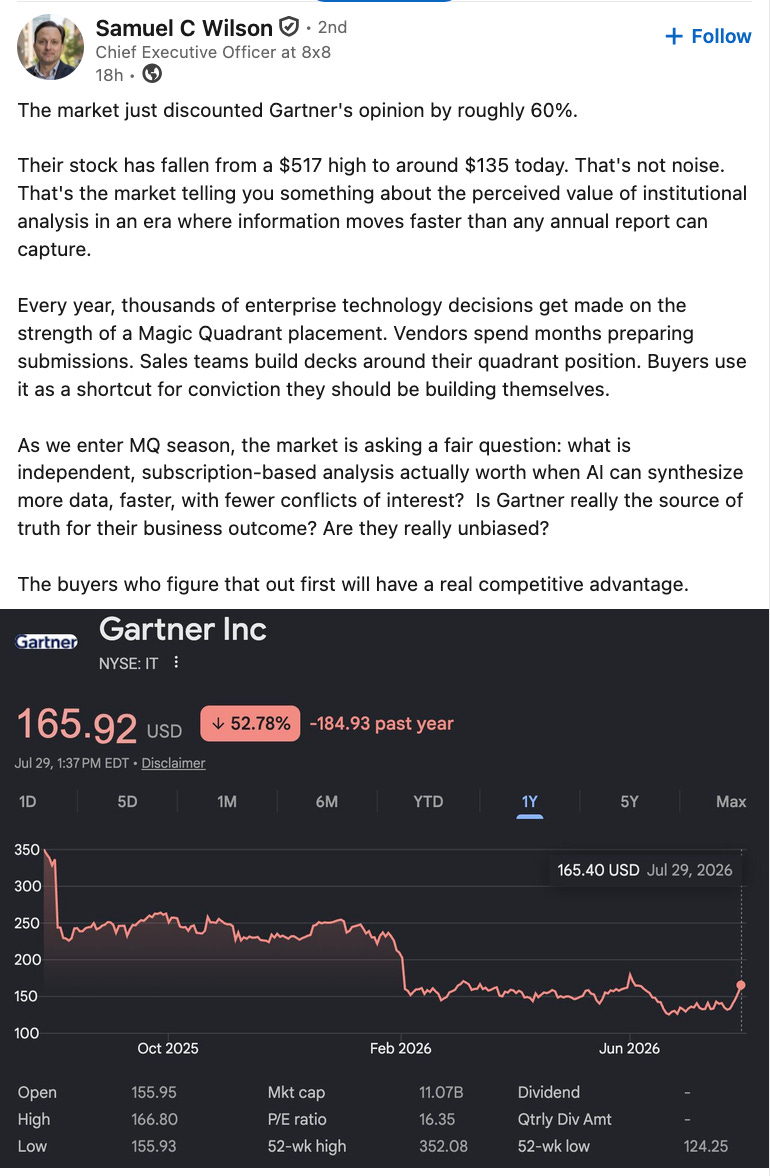
Carter Lusher, renown ‘analyst of analyst firms,’ was one of the first to jump in. He corrected Samuel’s math, it’s actually a 74% decline from IT’s all time high of $547.50 on November 4, 2024. Lusher correctly points out that Gartner’s woes started before ChatGPT was released with peak contract value
But here’s the problem with the popular “AI killed Gartner” narrative: Gartner’s GTS client count peaked in 4Q21 and has been declining for 17 consecutive quarters. -Carter Lusher
That peak in Global Technology Sales (GTS) customers was 14,149 in Q4 2021.
The most recently reported count is 11,487 in Q1 2026, reported on May 5, 2026, down 18.8%.
There is no denying that the advent of AI is seriously impacting the value proposition of Gartner. Anyone with a $20/month subscription to ChatGPT or Claude can get instant analysis of major technology vendors and their products. Multi-page reports can be generated in minutes. The frontier models can conduct dozens of Google searches, compile hundreds of pages of data and distill an analysis in the time it takes to fill out the Gartner Inquiry form to schedule a call with an analyst four weeks out. But, as Lusher points out, Gartner started to lose clients in 2021.
What has happened over the years is a dramatic change in the information technology landscape. Where once there were a dozen players in each field now there are hundreds. Every new shift in the tech landscape only serves to multiply the available options. Case in point: the dawn of the AI age catapulted the frontier model companies from strange non-profit research labs to the most highly valued companies in the world, (albeit, still strangely organized.)
Analysts love to jump on the next new shiny toy as much as any geek. Recall the excitement over the Segway and predictions that the face of cities would be transfigured. But one layer down from frontier models are new vendors that launch with ideas about leveraging AI to accomplish old tasks. In security that means: SOC Automation, Vulnerability Management, GRC, Pen-testing, email security, and everything else.
Analyst firms have always had the luxury of waiting as markets develop. Few of their customers are early adapters so they do not get a lot of questions regarding just-launched companies. They do not have time to get briefed by the 542 AI Security vendors tracked by IT-Harvest.
I commented on Samuel’s post and have been stunned by the attention a single comment has received.
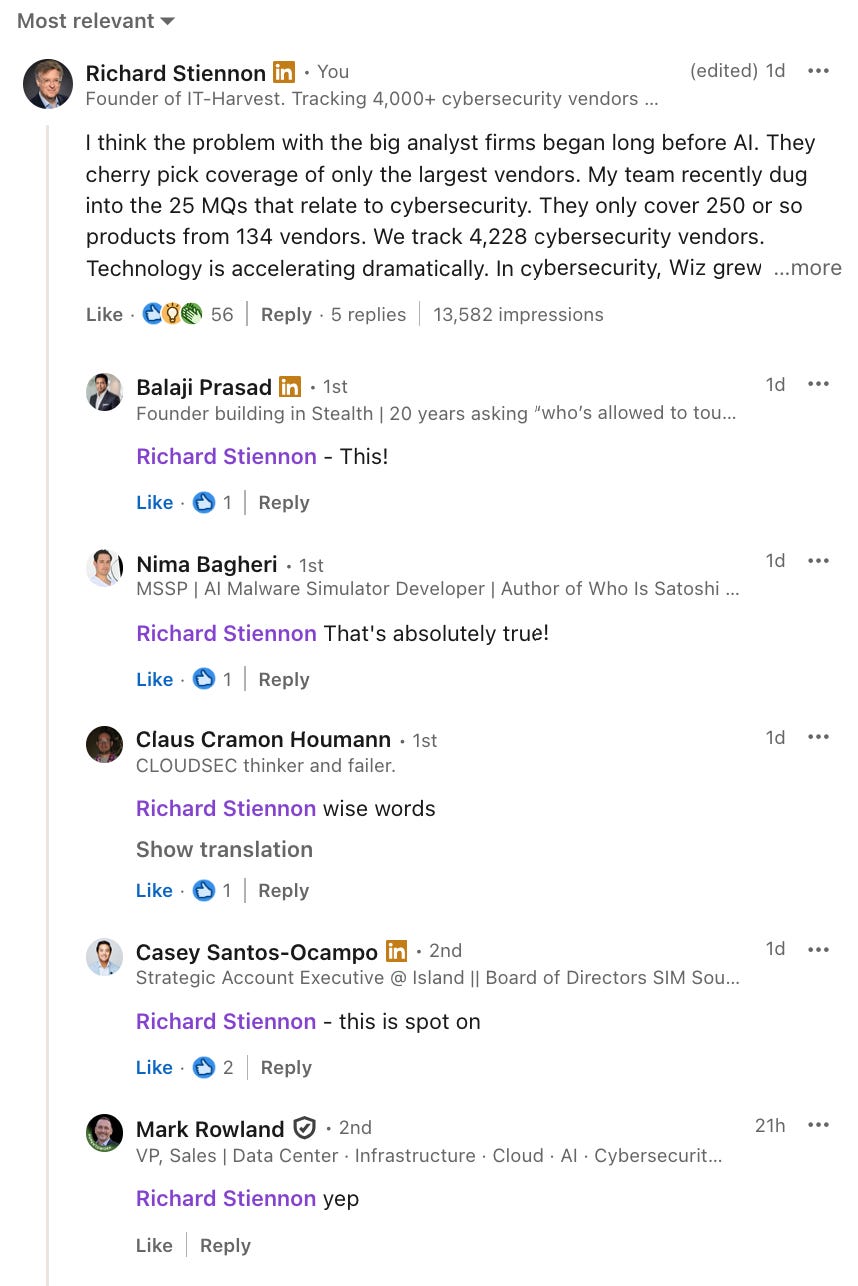
56 reactions, 13,582 impressions, and look at those comments. All are affirming a frustration with Gartner’s lack of vision into the larger ecosystem of 4,250 cybersecurity vendors.
On the same day I talked to a CIO who subscribes to the Dashboard. They are a small manufacturer with a well known name. They recently canceled their Gartner subscription. For security they turned to IT-Harvest. They are a forward thinking company and like to work with startups; companies that do not get much love from Gartner.
Gartner has managed to extract more and more revenue from fewer clients every quarter. I suspect that there is an upper limit to enterprise tolerance for that kind of spend. Gartner has to adopt a long-tail approach and create lower priced product offerings to capture any percentage of the 140,000 enterprises that they have identified as their Total Addressable Market.